Showing posts with label Kansas Farm Bureau. Show all posts

Sunday, November 6, 2016

Shredded Beef - Freezer Meal

Many of the many freezer meals prepared at the Kansas Farm
Bureau "Train the Trainer" session. 
Freezer meals are a popular food concept  now. The idea of quick weeknight meals after a few hours of prep ahead on the weekend makes sense. Even though I have more week day time for food prep now, I'm enjoying the convenience of having a supply of freezer meals for quick preparations.  
 
Recently I attended a session by Chef Alli on Freezer Meals. Sponsored by Kansas Farm Bureau, and called Train the Trainer, it was aimed to Family and Consumer Sciences teachers and Extension agents as well as involved community members or County Farm Bureau board members. Our Greenwood County group was the high school FACS teacher, the K-State Research and Extension county FCS agent, our Farm Bureau county coordinator and myself. We had a great time learning more about telling the agriculture story, how the food produced in Kansas is viewed around the world, and hearing from some women ag producers who do a good job of telling their story. The afternoon with Chef Alli was a hands-on demonstration of how to share the story of ag products through food preparation. 
Our Greenwood County crew
Each group prepared 4 of the provided 10 meal packages and each person had 4 meals to take home. The preparation method uses lots of plastic bags to contain the ingredients for freezing, but I think at home some freezer-oven cookware could also be used. Here's one of the recipes our family enjoyed. It made a very tender and tasty beef roast with ingredients I usually have. Using the slow cooker made it especially simple. I cooked the meat all day Saturday, shredded it in the late afternoon and prepared the sandwiches on Sunday. I'll do this recipe again even without the freezer assembly. 
Our preparation at home, hamburger buns instead of
hoagies, with BBQ sauce, onions, beef and cheese. 


Lazy-Butt Pepperoncini Beef Subs


Freezer Prep:
1. Add the following ingredients to a gallon bag and massage to combine:
            4 cloves peeled garlic
            2 cups pepperoncini with juice
2. Add 1 chuck roast (3-4 pounds) to prepared ingredients in gallon bag, then massage bag to combine ingredients with roast; seal bag.
3. Cut 6 slices provolone cheese in half to make 12 elongated pieces, then place into a new quart bag; seal bag, then attach cooking directions label
4. Place both bags of ingredients into new gallon bag and seal.

The prep is simple. Thaw in refrigerator 1-2 days before cooking.
For these beef subs you will need to purchase hoagie buns and make Caramelized Onions (recipe below).
 Place roast and contents of bag into a greased slow cooker; cover slow cooker and cook on low setting for 7-8 hours, or until beef shreds easily with a fork and is very fork-tender. Brush hoagie buns with olive oil and place onto a baking sheet; bake in preheated 375 degree oven for a few minutes until toasted. Dress buns with a bit of bbq sauce; top with caramelized onions (recipe below), warm shredded beef, and provided provolone slices. Pop subs into a very hot oven for just a few minutes until cheese melts. Serve at once! 

Caramelized Onions

Thinly slice 2-3 pounds yellow onions. In a large, heavy skillet, heat 2-3 Tbs. canola oil over medium high heat; add onions to pan and sauté, stirring, until onions begin to soften. Reduce heat to medium low; add a splash of white wine, a splash of good balsamic vinegar, and 1-2 Tbs. dark brown sugar. Cover pan and cook low and slow until onions are a deep golden brown in color, stirring often. Season to taste with kosher salt and freshly ground black pepper.

Good served with baked beans and coleslaw 

Jan’s Note: I reduced the amount of onions to what would be needed for one meal for our family (6 sandwiches) and used 3 large onions. Then as the remaining meat was used for sandwiches, I caramelized more onions as needed.

Friday, September 30, 2016

National Coffee Day

Yesterday was National Coffee Day - a day to celebrate our caffeine habit and get a free cup of coffee at selected coffee houses. For many of us, Coffee Day is the way we start each day. My house offers a steaming pot of brew each morning, this week's flavor is Pumpkin Spice, anticipating the fall season. Yesterday's publicity of National Coffee Day reminded me of the coffee farms we toured in Hawaii. It was interesting to see coffee as a red bean on a short tree/shrub instead of a dark ground product in a bag.
Coffee is, and has historically been, one of Hawaii's main crops. The first coffee plant was introduced to Hawaii through King Kamehameha in 1813. In 1821, the first coffee tree was planted in Kona on the Big Island of Hawaii by a missionary. Thus, the exquisite taste of the cup of Kona coffee had begun. Kona coffee is grown in a 20-mile area that offers just the right temperatures, rainfall, and mix of volcanic soil to produce the distinct flavor. Today the largest coffee farm there has 4 million trees.
There are 715 small coffee farms in the state of Hawaii, some on each island. Hawaii is the only state in the U.S. which grows coffee.
Coffee trees grow in rows in rich volcanic soil that reminded us
of Oklahoma red dirt. 

The trees are not large, and are trimmed every other year or every third year. 

Beans, called cherries, grow in clusters along the stem.
They are harvested after about 7 - 9 months. Each cherry contains
two small beans. 

Beans/cherries may be strip picked with a harvester machine such
as this one or selective picked by hand taking only the ripe cherries. 

Coffee beans are sorted and separated then dried. Other processing includes
hulling, polishing, and roasting.


The folks at Eating Well have given tips for brewing the best cup of coffee. It gives us something to think about, maybe a change of the plastic-can-brand to the grind-it-in-the-store (or at home) varieties. What ever  your habits are, there are some tips you can use:
1. Buy fresh beans
2. Keep beans fresh at home. They suggest to buy only a 5-7 day supply at a time and keep them in a glass canning jar with a tight fitting lid.
3. Choose good coffee - 100% arabica beans.
4. Grind your own.
5. Use good water.
6. Avoid cheap filters.
7. Don't skimp on the coffee. Their formula is 2 level tablespoons of ground coffee for 6 ounces of water/coffee.
8. Beware of the heat, best temperature is 200 degrees.
9. Keep your equipment clean.

The simple cup of morning joe - gives us a lot to think about. Enjoy the brew.


Sunday, April 17, 2016

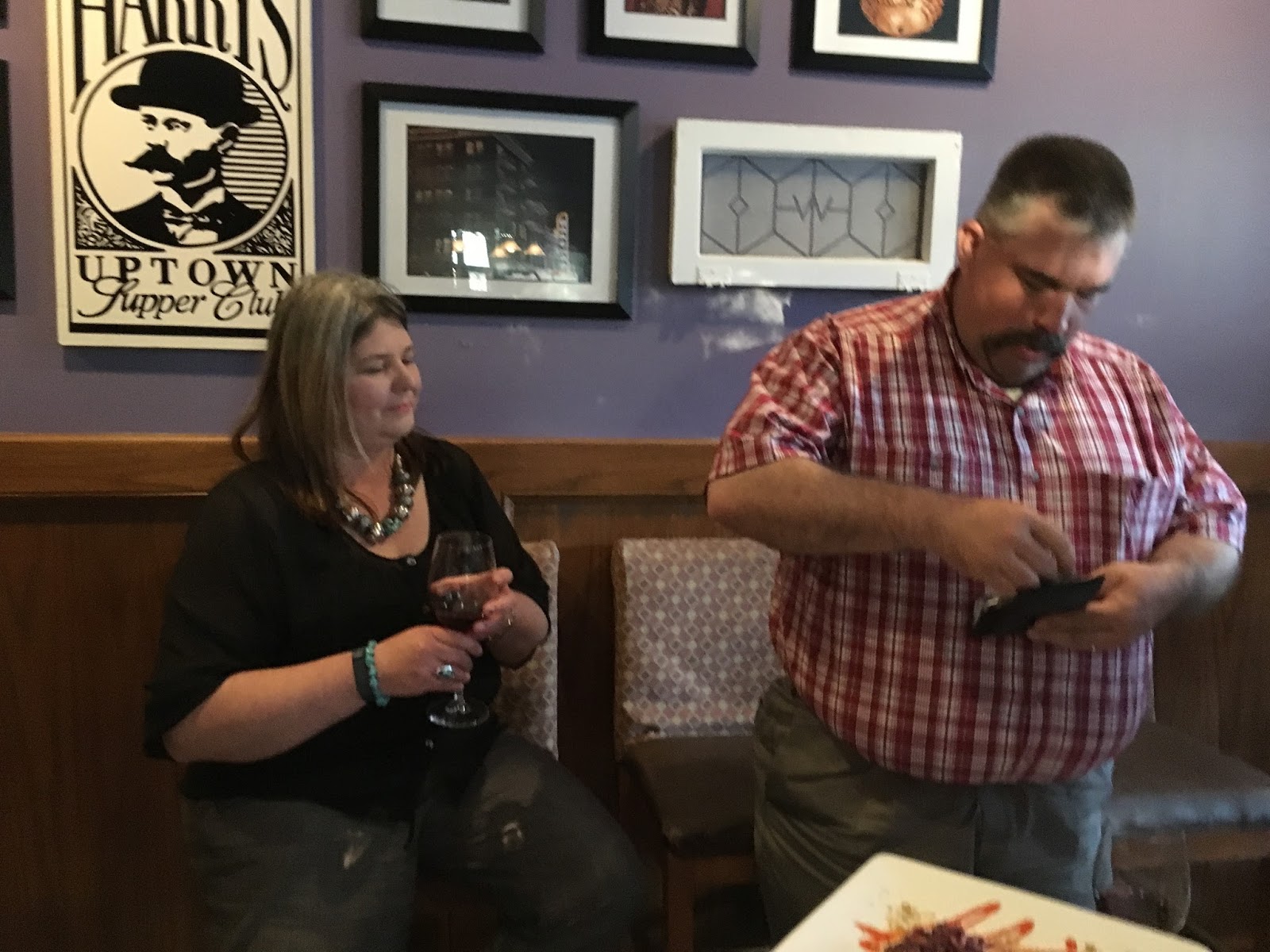
Restaurant Crawl - Harry's

After the Pork Belly and wine at Four Olives our Restaurant Tour of Manhattan'a Aggieville continued onto Poyntz Street to Harry's. This downtown landmark is familiar  to everyone who has spent any time in Manhattan, Kansas. Build in 1925 by Harry Wareham as a theater, hotel and lavish apartments, it was the town's first tall building with 6 stories. It was know for it's beauty, history and fine dining. The flood of 1952 damaged the building as well as much of downtown Manhattan. In 1984, the building was renovated and has since then reclaimed the glory of past years. The website (http://www.harrysmanhattan.com) lists many awards of state, regional, and national acclaim.
The chef explained to us that he has been with Harry's for 25 years and assists with the other 2 locations associated with Harry's - Harry's Deli and Bourbon and Bakery.

Glenn is handing out business cards
to direct people to his blog, newscolumn
and ranch. 
At this stop it was fun to see another friendly agriculture producer pair, Glenn and Jennifer Brunkow. Glenn worked with K-State Extension for 19 years and was known by many of us. He has become an advocate for agriculture through his newspaper, his blog, and Farm Bureau work. He and Jennifer shared their passion for farming and ranching and family as they told of the importance of bridging the gap from farmers to consumers. Their farm includes cattle, sheep, soybeans, wheat, hay and lots of 4-H projects. Glenn explained the importance of the Beef Quality Assurance program, a training and certification process for cattle producers to assure animal health and well-being as well as provide a safe, quality product. My rancher husband and daughter have taken this program and found it reassuring to realize the practices they were using were those recommended by BQA.

For this food tasting we were served Prime Strip Beef Loin marinated in herbed olive oil and roasted. It was beautiful and delicious.

Monday, April 11, 2016

Restaurant Crawl - Four Olives

A few weeks ago I went on a "Restaurant Crawl", or "Restaurant Tour" in Manhattan, as I chose to call it to my family who must have had personal memories of "Pub Crawl" from their times in Manhattan, while at KSU! I assured them the focus was on food, drink was only a small part of the menu.
The event was planned by the Kansas Nutrition Council and I thought it would be fun to attend and also to learn some updated information about food, nutrition, and food trends. The Crawl/Tour was sponsored by the Kansas Farmers and Ranchers to tell stories of agriculture and where our food comes from. What a good idea it was to partner with the Kansas Nutrition Council which includes many food professionals who make food decisions for schools, hospitals, and other groups as well as many who teach food and nutrition in Extension or classrooms.
I wasn't familiar with the Kansas Farmers and Ranchers organization, and as we have several membership and information from various farm and ranch groups, I was also curious. The KFR is an umbrella group to include several agriculture organizations. Thank you to the Kansas Farm Bureau, Ks. Wheat, Ks. Pork Producers, Ks Soybean Commission, Ks. Common Ground, Ks. Beef Council, and Midwest Dairy.
The first stop for our group was Four Olives, an upscale contemporary restaurant and wine bar. (http://www.fourolives.biz). The chef explained the entree we were served - Pork Belly braised in root beer spice with wilted spinach and polenta (a cornmeal sort of mush). Since the featured food was pork, two couples who were swine producers told us about their operations. Greg and Amy Goode supply pork to speciality markets and chefs. Besides Four Olives, their pork goes to California and the East Coast. They have developed their swine operation to produce a leaner belly hog with high meat quality. One of their goals is to have a relationship with the end users and they have sponsored farm tours for chefs. Pork Belly as we were served is cured and similar to bacon. The root beer spice gives a spicy flavor to compliment the pork.
Also at that stop Kristy and Michael Springer from southeast Kansas explained their swine operation. Their operation employs 30 people besides their family which is the third generation in the operation. Springer Swine produces 80,000 hogs a year, with about 1500 pigs born each week. When Don and I were first married, we had a small hog operation, so I have a bit of a sense about how much work that involves! Kristy and Michael shared their pride in agriculture and family as they spoke. It was extra fun to learn that Kristy grew up in Eureka!
The chef at Four Olives
explains the entree.

Pork Belly braised in root beer spices
with spinach and polenta.
Next blog will tell of the other two stops on the Restaurant Crawl.