Friday, November 18, 2011

Home Made Bread Day

Yesterday, November 17, was HomeMade Bread Day - not at my house, I was too busy elsewhere. But this month has been a time of baking as the weather turns cooler and we think of cozy warm kitchens. Yeast breads can be a challenge, taking both skill and time, but I've found a great way to make the most of both - the bread machine.

Several of my favorite bread recipes use the bread machine. It had been delegated to the store room, but now comes out regularly. Using the bread machine for dough, as this cinnamon roll recipe does, doesn't speed up the process (my bread machine takes 2 hours and 45 minutes for dough cycle) but I can do several other things while the machine does the mixing and kneading for me.

Usually I don't put brand names in my recipes, but King Arthur Flour is so good, it does make a difference! This company was one of the sponsors of the National Festival of Breads, coordinated by the Kansas Wheat Commission last summer, and they have a good website (where I got this recipe) and great products.

So here's our family's new favorite for Cinnamon Rolls:


Dough:
1 packet “highly active” active dry yeast; or 2 ½ teaspoons active dry yeast; or 2 ½ teaspoons instant yeast
7/8 – 1 1/8 cups lukewarm water (I use 1 cup. If the humidity is high use the lesser amount, if it is dry, use the greater amount)
3 cups King Arthur Unbleached All-Purpose Flour
6 tablespoons unsalted butter, at room temperature
3 tablespoons sugar
1 ¼ teaspoons salt
¼ cup nonfat dry milk
½ cup instant mashed potato flakes

1) Make the dough. If you’re using active dry yeast, dissolve it with a pinch of sugar in 2 tablespoons of the lukewarm water. Let the yeast and water sit at room temperature for 15 minutes, until the mixture has bubbled and expanded. If you’re using instant yeast, you can skip this step.
2) Combine the dissolved yeast (or instant yeast) with the remainder or the dough ingredients. Mix and knead everything together – by hand, mixer or bread machine set on the dough cycle – until you’ve made a smooth dough. If you’re kneading in a stand mixer, it should take about 7 minutes at second speed, and the dough should barely clean the sides of the bowl, perhaps sticking a bit at the bottom. In a bread machine (or by hand), it should form a smooth ball.


3) Place the dough in a lightly greased bowl. Cover the bowl, and allow the dough to rise, at room temperature, till its nearly doubled in bulk, about 1 – 2 hours. Rising may take longer especially if you’ve kneaded by hand.  Give it enough time to become quite puffy.
4) While the dough is rising, lightly grease pans (Two 9” round cake pans or a large jelly-roll pan)
5) Transfer the risen dough to a lightly greased work surface, and pat or roll it into a 16” x 12” rectangle. (Greasing the work surface and your hands for this soft dough works great - and doesn't add any extra raw flour to the dough.)
6) Brush dough lightly with milk. Whisk together the sugar, cinnamon and flour and sprinkle evenly over the dough, covering the entire surface. Sprinkle on crasins.
7) Roll the dough into a log the long way, stretching to about 20” in length as you roll.
8) Using a serrated knife, or strong thread, slice the log into slices about 1 inch thick. (I like to use a quilting thread to wrap around the dough to slice evenly and neatly) Place rolls in prepared pan and flatten gently.
9) Cover the pan and let the rolls rise until they’re noticeably puffy, about 1 ½ - 2 hours. They should spread out and start to crowd one another.
10) While the rolls are rising, preheat the oven to 375 degrees. Bake rolls till they’re brown around the edges and beginning to turn gold brown across the center, about 20 minutes.


10) Remove the rolls from the oven and drizzle icing over them. For icing, I mix 1 cup powdered sugar with enough (1 tablespoons or so) liquid flavored coffee creamer to make a glaze. Some people like a soft spreadable icing that is thicker – use more powdered sugar.

Now, make Home Made Bread day happen often at your house and enjoy! 

Sunday, November 6, 2011

Pumped for Pumpkins


Pumpkins are such a fall favorite that I've collected lots of recipes. The fact that son and son-in-law are pumpkin-flavor fans has us making everything pumpkin from morning oatmeal and lattes to pumpkin roll desserts, with lots of experiments in between.
This week I tried pumpkin with my morning oatmeal. I discovered stone-ground oatmeal a couple of years ago and make it in batches for 4 or 5 days at a time. This pumpkin oatmeal can be done the same way. The recipe is for 2 servings, but they are generous servings, I divided mine into 3. Since its made in the oven, no watching the pan on the stove for boil overs! Just stir together and set the timer.

Pumpkin Spice Oatmeal
1 cup old-fashioned oats
2 tablespoons brown sugar
1/2 teaspoon cinnamon
1/4 teaspoon allspice
1/8 teaspoon nutmeg
pinch of salt
3/4 cup pumpkin puree
3/4 cup skim milk
     Preheat oven to 350 degrees. Combine ingredients in a bowl and stir. Put into baking dish sprayed   with nonstick spray. You could bake this in individual dishes as it will be served. Bake 10 minutes. Combine topping (2 tablespoons slivered almonds, 2 teaspoons brown sugar and 1 teaspoon butter) and sprinkle over top. Return to the oven and cook an additional 10 minutes.
   I prepare extras for future mornings, cover with plastic wrap and keep in the refrigerator. An easy breakfast - just add a splash of milk and pop in the microwave for a couple of minutes.

With the holiday baking season we will be using lots of spices, so it is a good time to check supplies and make sure the spices in the cabinet are fresh. I've been guilty of having spices older than my kids! While they will still be safe, they may not be as tasty. Many fall recipes call for pumpkin pie spice, a simply substitution is 1 teaspoon cinnamon + 1/4 teaspoon ginger + 1/8 teaspoon nutmeg + 1/8 teaspoon allspice. I've also discovered that Vietnamese or Saigon cinnamon has a better flavor than regular cinnamon, less bitter and more citrus. The K-State fact sheet that I did while working is on the K-State Research & Extension website:   http://www.ksre.ksu.edu/library/fntr2/mf2920.pdf

Another favorite is Pumpkin Spice Latte, an expensive treat from the coffeeshop, and not available in my town. So my home 'brew' is: microwave a cup (or less) of skim milk, 2 tablespoons of pumpkin spice coffee creamer, and (optional) about 1/4 cup bottled vanilla frappuccino in a large mug; when heated, whisk the milk (there are handheld electric mini-whisks just for this) to froth and increase the volume. Carefully pour hot, strong coffee (about 1/4 cup) into the side of the frothy milk mixture. (I use reheated leftover-from-the-morning coffee). Sprinkle with pumpkin pie spice or cinnamon. Now charge yourself $4.25 for a grande size.

Three weeks until Thanksgiving. How many more pumpkin recipes can I make for the guys?

Monday, October 31, 2011

Pumpkin Bumpkin

The fall is surely pumpkin time, one of our favorite flavors. Pumpkins have been American favorites for centuries, and connected with history and folklore through the ages. The Indians roasted strips of pumpkin for food. Colonists sliced off the top, removed the seeds and filled the center with milk, spices and honey which they baked in hot ashes; probably the beginning of pumpkin pie. Folklore is filled with pumpkins in stories and fairy tales. Cinderella rode to her dream-of-a-lifetime ball in a pumpkin-turned-coach. She just had to remember to be home by midnight (have you heard someone say they'll turn into a pumpkin if they don't go home early?).  Peter, Peter Pumpkin Eater kept his wife in a pumpkin (not an appealing adobe). And, on Halloween, let's not forget The Legend of Sleepy Hollow with Ichabod Crane disappearing after meeting the headless horseman, leaving behind his horse, his hat, and a pumpkin.

Today, I haven't heard any modern pumpkin stories, just good pumpkin recipes. And its a food you can enjoy for the taste and for the nutrition. The orange color of pumpkin is a sign of the rich antioxidant beta carotene, and Vitamin A. This nutrient may help reduce the risks of certain cancers and protect against heart disease as well as some degenerative aspects of aging. And, if you're worried about freckles or snakebite, Indian legends claim that pumpkins are good for curing both!

Most of the pumpkin supply is available in October and the fall is my favorite time for baking with pumpkin. I recently visited son Clint in Iowa and did a 'pumpkin weekend', making pumpkin bread, pumpkin muffins, and pumpkin pie.  Here's my recipe for pumpkin muffins, quick and easy, and extra good!


WHOLE WHEAT PUMPKIN APPLESAUCE MUFFINS


2 cups whole wheat flour (or blend)
1 teaspoon baking powder
¼ teaspoon baking soda
1 teaspoon salt
2 teaspoons pumpkin pie spice
2/3 cup brown sugar, firmly packed
⅓ cup white sugar
¼ cup canola oil
½ cup applesauce
½ cup canned pumpkin
⅓ cup buttermilk (or 1 tsp lemon juice + milk = ⅓ cup)
2 eggs, slightly beaten

Preheat oven to 400 degrees. Grease 12 muffin cups.
Whisk together flour, baking powder, baking soda, salt and pumpkin pie spice in a large bowl; set aside.
Beat eggs. Combine brown sugar, white sugar, oil, applesauce,, pumpkin, buttermilk, and eggs in a medium bowl. Mix until well blended. Pour the pumpkin mixture into the dry ingredients and stir until combined. Fold in raisins and pecans, if desired (1/4 cup each)
Divide the batter evenly in 12 muffin tins. Bake 15 – 20 minutes. Cool on wire rack and remove from pan. 

another favorite, and quick-to-do recipe, is this one for pumpkin bars: I made this for church coffee time earlier in the fall. 

Pumpkin Spice Frosted Snack Bars

1 pkg. (2-layer size) spice cake mix
1 can (15 oz) pumpkin
1 cup Miracle Whip dressing
3 eggs

Preheat oven to 350 degrees, beat cake mix, pumpkin, dressing and eggs in large bowl with electric mixer on medium speed until well blended. Pour into greased 15x10x1-inch pan.
 Bake 20-22 minutes or until wooden toothpick inserted in center comes out clean. Cool completely on wire rack.
 Frosting:  (or if you're in a hurry, use a can of ready-to-spread cream cheese frosting)
1 pkg (8 oz) cream cheese, softened
2 Tbsp milk
1 tsp vanilla
1 pkg (16 oz) powdered sugar (about 4 cups)

Beat cream cheese, butter, milk and vanilla in large bowl with electric mixer on medium speed until well blended. Gradually add sugar beating after each addition until well blended. Spread over cooled cake. Cut in to bars to serve. Store any leftover bars in tightly covered container in refrigerator. 

Sunday, October 16, 2011

Crumbs from Germany

Crumbs - the tasty small bits broken from the whole. Thats what this blog is - bits and pieces of food pictures and trivia from our River Cruise through the Netherlands and Germany that didn't fit with the other blogs (Apple Strudel 10/12; Sweet Dishes 10/11; The German Table 10/10; German Beef Rolls 9/13; and Garnished! 9/9).

I'm not sure there are still 'traditional' German foods as food preferences everywhere are constantly evolving. Some regional dishes have blended to become national or international. Other cultures have added flavors. Lifestyles and health concerns changed preferences. But we still found unique food trends and deep held traditions in the 'street food' of Germany.

People in Germany, like in the U.S., buy much of their food on the street. Whether it is a local bakery, a sandwich shop, or a small grocery store - convenience, location and taste are important. The grocery stores we saw were much smaller than our supermarkets, but I'm sure there were larger markets farther away from the town centers where we were touring.

Pretzels always come to mind with German food - Pretzels, sausages and beer.
Pretzels are often served with mustard - we did a bit of shopping for things to bring home and bought German mustard (senf). Mustard, and many jams and other condiments, are sold in tubes. Just be sure you don't brush your teeth with it!

At lunch during a Frankfurt tour outing, we ate at a local restaurant, the food served was similar to a German ravioli. It is called "maultaschen", supposedly developed by monks in the 16th century who wanted to eat meat (and hide it from the Lord) during Lent, so they mixed the meat with spinach and herbs and hid the mixture in dough pockets.


 Many shops and stores have large signs to illustrate what they offer. Makes it much easier than trying to read German! This is a pretzel shop.....

Bakeries are on many streets, as everyone likes sweet treats. The Berliner is a popular German, and Dutch, jelly-filled donut. When President Kennedy visited Berlin in 1963 during the Cold War, he meant to express solidarity with the people of Berlin, but instead he said "I am a jelly donut".


Other sweet treats were Schneeballens - Snowballs. It seems every cuisine from the State Fair to fine French cooking has a favorite fried dough recipe. The Snowballs were strips of dough formed into a ball, deep fat fried and coated with powdered sugar.

We like to look at grocery stores when we travel, even if its Dillion's in Wichita! Just to see what other people might be buying for their foods. We always check out the meat counter. In Karlstadt we compared the milk products and meat . "fleisch" is meat, Hackfleisch is ground meat. 
In Nurnberg we saw representations of tradition and today. Saturday's activity filled the town square with street market stalls of fruits, vegetables, flowers and baked goods. The McDonalds (also know as the unofficial American Embassy) was right behind the street market. Guess where the tour group headed on a rainy morning! 

Sampling the food and learning about a country's culture through food are part of the fun of traveling. We sometimes find things we like and will adapt at home (German Meat Rolls) and some we won't try again (roasted duck). I'm sure our Taste of Germany was only a small sample of the foods German families enjoy, just as I hope travelers to the U.S. don't think that we eat hot dogs and popcorn all the time (although popcorn is one of my favorite foods!) 

Wednesday, October 12, 2011

Apple Strudel

Apples are a fall favorite in many countries and apple strudel is a favorite German dessert.  Strudel is a pastry with a filling rolled up in a very thinly stretched dough. The name "Strudel" means Whirlpool since the dough is rolled and the center of the pastry resembles a whirlpool. After the ship chef's demonstration of Apple Strudel and the delicious dessert at dinner that night, it was something I wanted to try. But I had memories of a long ago Extension lesson with much kneading, rolling and folding. Traditional strudel dough is made with high-gluten flour, water, and oil. Preparing the dough requires intense kneading to develop the gluten, followed by resting for the dough (and the baker!).  The dough becomes elastic enough to be stretched into a very thin sheet that is almost transparent.

Easier recipes, such as the one the ship chef used, substitute the traditional dough with a ready-made phyllo-dough or puff-pastry.  But the chef's demonstration still seemed difficult to follow:
His recipe, spoken with a heavy German accent, is: Apple 1 kg, Sauer cream 200 g, Hazelnut powder 100 g, Raisin 200 g, Cinamoon powder 50 g, Butter 1 pk, Sugar 350 g. It was made with philo dogh layers and baked at 180 C degrees for 20 minut.

But luckily Taste of Home has a similar recipe with American measurements and instructions. The bonus is that it is easier and quicker, as well as lower in calories that the traditional strudel recipes. This recipe uses phyllo dough. I discovered that the original recipe for Strudel was called 'phyllo', which means 'leaf', by the Greeks who first perfected strudel, thus named because it was so thin. So, using phyllo dough for your strudel may be going back to the beginnings of the custom.

APPLE STRUDEL
Ingredients:
1/3 cup raisins
2 tablespoons water
1/4 teaspoon almond extract
3 cups coarsely chopped peeled apples
1/3 cup plus 2 teaspoons sugar, divided
3 tablespoons all-purpose flour
1/4 teaspoon ground cinnamon
8 sheets phyllo dough (14 inches x 9 inches)
2 tablespoons butter, melted
2 tablespoons canola oil
Directions:
* In a microwave-safe bowl, combine the raisins, water and almond extract. Microwave, uncovered, on high for 1-1/2 minutes, let stand for 5 minutes. (this smells wonderful) Drain. Add the apples, 1/3 cup sugar, flour and cinnamon; toss to coat. Set aside.
* Place 1 sheet of phyllo dough on a work surface. Combine butter and oil; set aside 2 teaspoons. Lightly brush some of the remaining butter mixture over the phyllo dough. Keep remaining phyllo dough covered with plastic wrap and a damp towel to avoid drying out. Layer with 7 more sheets of phyllo, brushing each layer with some of the butter mixture. Spread apple mixture over phyllo to within 2 inches of one long side. Fold the short edges over filling. Roll up jelly-roll style, starting from the long side where the apple filling is 2 inches from the edge.
* Place seam side down on a baking sheet coated with cooking spray. With sharp knife, cut diagonal slits into top of strudel. Brush with reserved butter mixture. Sprinkle with remaining (2 teas.) sugar. Bake at 350 degrees for 35-40 minutes or until golden.
If cut into 4 servings, this is only 205 calories per serving, but I thought it was large enough for 6 or 8 servings. That makes the calories so low you could even serve it with ice cream! 

Tuesday, October 11, 2011

"susse Speisen" - Sweet Dishes

At the end of a meal we often enjoy desserts, or sweet dishes. The desserts in Germany on our River Cruise were delightful! When we think of German desserts, stollen (yeast fruit bread), Lebkucken (gingerbread), Black Forest Cherry Cake, Apple Strudel, and rich cheesecakes probably come to mind. Those are all German favorites, as well as many lighter fares such as cream puddings, custards and fresh fruit. These are especially tasty after the heavier meals often served.

We learned of many special German food inventions and traditions. Did you know Gummi bears were invented in Germany? The ship chef demonstrated Apple Strudel on board, but that's a topic for the next blog! Here are some pictures of the German desserts we enjoyed on ship.

Lemon white wine cream with merenque and berries

Creme caramel and almond panna cotta with fresh fruits

Black forest cake, served in the glas

Melted choclate cake with almond panna cotta and fresh fruit

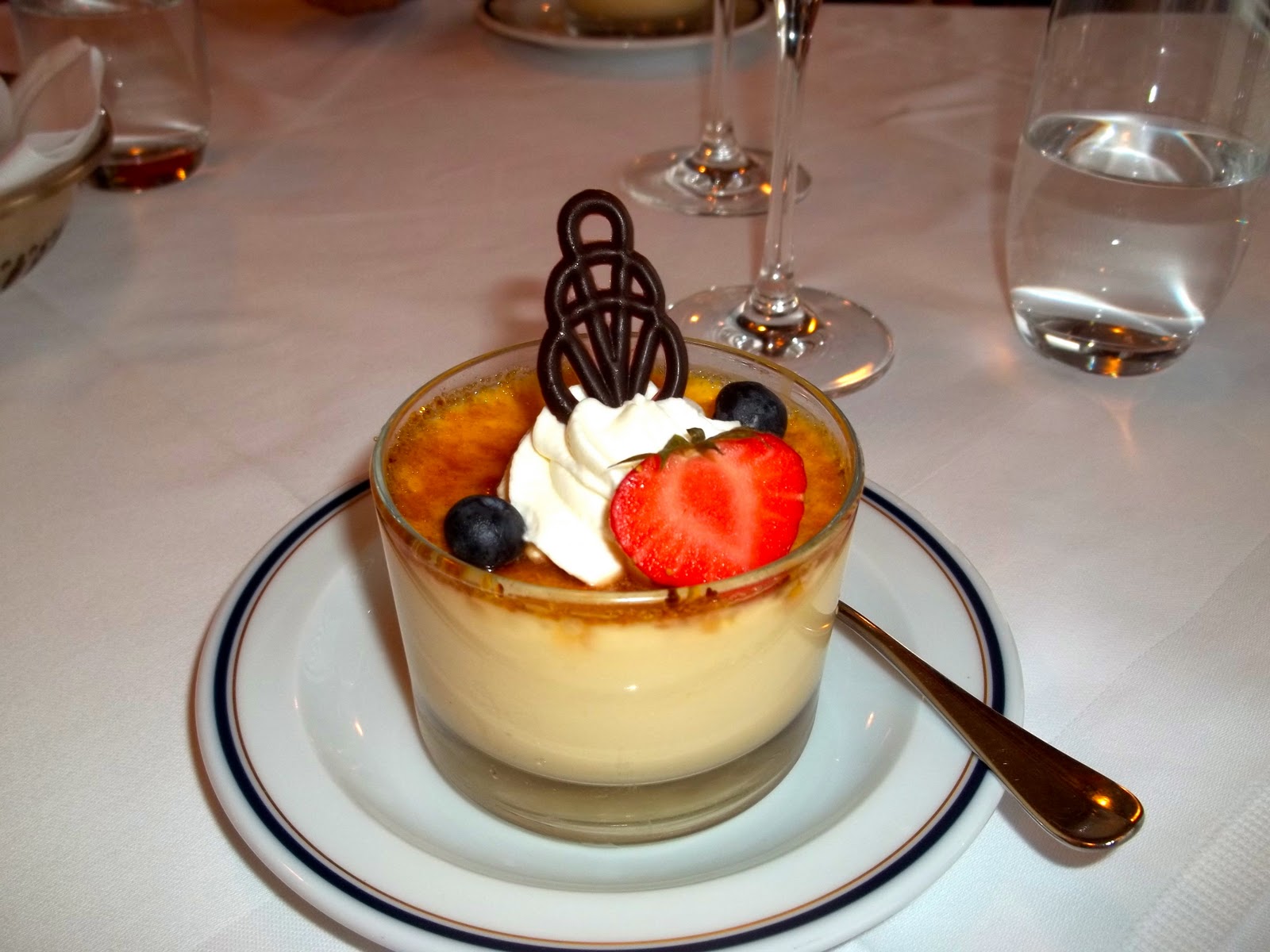
Creme brulee with fresh fruits

Apple crumble cake with Bourbon vanilla ice cream

Apricot dumpling on orange sauce and ice cream

Apple strudel with vanilla ice cream

Warm plum crumble cake with ice cream and cinnamon sauce

"Kaiser Schmarren" with marinated strawberries and ice cream

Baked Alaska

desserts served at Tea Time

Cream brulee with fresh fruits

Monday, October 10, 2011

The German Table

We've been back from our river cruise of the Rhine and Danube for almost 6 weeks now, the pictures are even in a scrapbook, and I keep thinking about the food. Maybe its because German cooking is similar to much of our American basic "meat and potatoes" meals. Many German main courses are based on beef, pork or veal, with frequent servings of fish also. A favorite is Schnitzel, which may be any type of cutlet (and we called it "chicken-fried steak"!). The Braten, or roast, is Germany's national dish. The flavors are similar to midwest favorites, not too spicy or hot, with thick sauces or gravies.

Most of the meals were served with several courses, starting with an appetizer, often a salad of some sort. This was followed by soup, usually cream of something. The joke on-board got to be that today's soup was cream-of-yesterday's-vegetable. By the end of the trip I was passing on the soup course.

This blog has a selection of pictures of the main courses we were served on the ship as we sailed through Germany.
Fried filet of Norwegean salmon with vegetable rice and grapefruit beurre blanc

Fried trout on warm German potato salad with sauce remoulade

Roasted pork tenderloin, homemade spaetzle, buttered broccoli and creamy chestnut mushroom sauce

Corn fed chicken breast with sweet potato mash, assorted vegetables and veal glace

German Wienerschnitzel; served with french fries

Whole marinated roastbeef, with green beans, stuffed potato and Marsala sauce

Roasted rack of lamb, ratatouille vegetables, wasabi puree and garlic jus

White fish picata with vegetables and tomato basil gnocchi

BBQ spareribs, sauteed corn and baked potato with sour cream

Argentinian beef tenderloin on broccoli mousse with pommes macaire, sauce choron and port wine glace (this was served under a silver domed cover)

Hungarian beef stew with bell pepper and herb rice

Even the airplane food was served in a unique way! notice the triangle plate and dishes that fit together on the serving tray.